
Djanogly Strelley
Academy
Languages
Spanish at DSA
Our Big Ideas
At Djanogly Strelley Academy, learning Spanish is an exciting journey into a new language and culture, focusing on communication, understanding, and global awareness. We teach Spanish through Key Stage 2, in years 3, 4,5 and 6.
Our curriculum is built around four core Curriculum Threads or 'Big Ideas':
- Diversity: Celebrating the variety of Spanish-speaking cultures and peoples across the globe.
- Identity: Encouraging pupils to express themselves and explore their own identity through a new language.
- Sustainability: Linking language learning to discussions about the world and environmental responsibility.
- Community: Using Spanish to connect with others and foster a sense of local and global community.
Our Approach - Communication and Confidence
We use the Language Angels scheme of work to deliver our Spanish curriculum, ensuring a structured and progressive learning experience. Our approach is focused on developing the four key language skills:
- Listening: Understanding spoken Spanish from teachers and native speakers.
- Speaking: Building confidence to respond, converse, and present in Spanish.
- Reading: Comprehending short texts, signs, and instructions.
- Writing: Constructing sentences and short paragraphs using learned vocabulary and grammar.
Lessons are interactive and engaging, using games, songs, and role-play to make the language memorable and fun.
Curriculum Overview - Our Learning Modules (KS2)
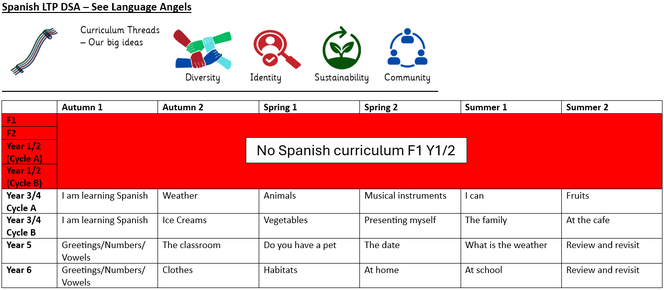
Our Spanish curriculum follows a structured Long Term Plan (LTP) and is carefully sequenced to ensure progression. Here is a snapshot of the modules taught across Key Stage 2:
Supporting Learning at Home - Ideas to Help
You can support your child's Spanish learning and cultural awareness by:
- Practising Greetings: Use simple greetings like ¡Hola! (Hello), ¡Adiós! (Goodbye), and Gracias (Thank you) at home.
- Exploring Culture: Watch child-friendly Spanish cartoons or movies (with subtitles), or listen to Spanish music.
- Counting and Naming: Practice counting or naming common objects (like fruits or clothes) in Spanish.
- Using Language Apps: Explore free language learning apps that offer beginner Spanish practice.
Try these websites/resources:
- BBC Bitesize Spanish (KS2 section)
- Language Angels (your child has a login which should be provided by the class teacher)
- Duolingo (Child-friendly mode)
Celebrating Our Learning
We celebrate our pupils' progress and passion for Spanish throughout the year by:
- Language Displays: Creating displays of pupil work, including descriptions, drawings, and cultural research.
- Role-Play and Performances: Giving children opportunities to use their speaking skills in front of the class or school.
- European Day of Languages: Taking part in special activities to celebrate language diversity.
- Singing Spanish Songs: Learning and performing traditional and modern songs in Spanish.
A module of Spanish at DSA
In Year 3/4 Cycle A, Autumn 2 they complete a module on Weather. Below is an overview of what that module includes.
Module Title: Weather (El Tiempo)
This module introduces essential vocabulary and structures needed to describe the weather, a topic central to everyday conversation.
Key Learning Objectives (What pupils will learn to do):
- Identify and name common weather conditions (e.g., sunny, rainy, cold).
- Ask and answer the question "What is the weather like today?" (¿Qué tiempo hace hoy?).
- Use the verb structures associated with describing the weather (Hace and Hay).
- Express personal preferences regarding different weather types.
- Create a simple weather report presentation.
Core Vocabulary and Phrases:
|
Spanish Phrase |
English Translation |
Focus Skill |
|---|---|---|
|
Hace sol |
It is sunny / It makes sun |
Speaking/Listening |
|
Hace frío |
It is cold / It makes cold |
Speaking/Listening |
|
Hace calor |
It is hot / It makes heat |
Speaking/Listening |
|
Llueve |
It is raining |
Reading/Writing |
|
Nieva |
It is snowing |
Reading/Writing |
|
Hay nubes |
It is cloudy / There are clouds |
Speaking/Reading |
|
¿Qué tiempo hace hoy? |
What is the weather like today? |
Communication |
|
Me gusta |
I like |
Grammar/Opinion |
Export to Sheets
Grammar and Phonics Focus:
- Weather Verbs: Introducing the key construction Hacer (to do/to make) for weather expressions (e.g., Hace viento - It is windy).
- Impersonal Verbs: Understanding the use of impersonal verbs like Llover (to rain) and Nevar (to snow).
- Pronunciation: Focusing on the correct sound of the Spanish 'H' (silent) and the 'LL' sound (like the 'y' in 'yes').
Cultural Context:
- Climate Comparison: Comparing the climate and typical weather in the UK with a Spanish-speaking city (e.g., Madrid, Seville, or a city in Latin America).
- Seasonal Activities: Discussing typical activities and clothing choices for different weather conditions in Spanish culture.
Assessment and Outcomes:
Pupils will demonstrate their learning by:
- Speaking: Accurately performing a short role-play conversation about the weather.
- Listening: Identifying weather conditions based on spoken descriptions.
- Project: Creating a simple mini-weather report or a poster that labels various weather conditions in Spanish.
 Visit our Trust website
Our Family of Schools
-

Castle View Primary School
-

Chellaston Academy
-

City of Derby Academy
-

Djanogly City Academy
-

Djanogly Northgate Academy
-

Djanogly Sherwood Academy
-

Djanogly Strelley Academy
-

Kensington Junior Academy
-

Hilltop Primary Academy and Nursery
-

Laceyfields Academy
-

Langley Mill Academy
-

Morton Primary Academy
-

QEGS Ashbourne
-

Springfield Academy
-

Springfield Junior School